
Core Production Courses.
Every TvF student takes production all four years. In 9th and 10th grade, students move through Production 1 to 4, a sequence of introductory courses that teaches the history and structure of the industry and the career paths within it.
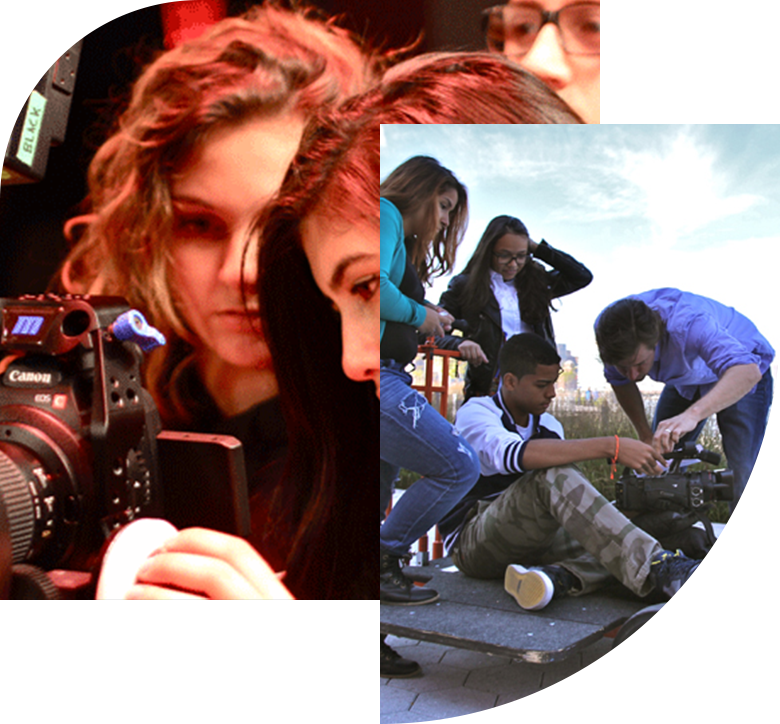
Students learn by making work. Each student directs five or more projects a year and crews on classmates' shoots, learning industry standards while exploring their own creative interests.
Specialized Production Sequences.
In 11th grade, each student joins one of seven production cohorts: Directing and Producing, Camera, Sound, Grip and Electric, Production Design, Post-Production, or Hair, Makeup and Wardrobe. Each cohort trains for the jobs in that department through direct instruction and advanced projects.
Extended days. Eleventh graders put that training to work on 16 to 18 extended days a year: 6 in the fall and 10 to 12 in the spring, filmed in rounds each term. Crews are assembled from all seven cohorts, just like a professional film crew. On an extended day, students report to their sets during lunch and advisory and keep working until 5 PM.
In the fall, crews make the Suspense Project, and in the spring, the Comedy Project. Both recreate scenes from real films. For the Comedy Project, crews of 30 to 40 students fully produce a 15 to 20 page script, with every student working in a real industry crew position.
Seven Cohorts, Seven Careers.
Each cohort trains students for real jobs in New York's film and TV industry. The figures below are median yearly pay in the New York City area for everyone working in each job, not starting salaries.
Directing and Producing. Script writing, storyboarding, directing, budgeting and scheduling, and production management. Producers and directors: $108,460, with jobs growing faster than average.
Camera. Camera operation and shot composition. Camera operators: $93,410.
Sound. Recording and managing sound on set. Sound engineering technicians: $97,510.
Grip and Electric. Lighting and grip equipment. Lighting technicians: $87,510.
Production Design. Set design and construction, set carpentry, set dressing and scenic art. Art directors: $142,990.
Post-Production. Video editing, motion graphics, sound design and sound mixing. Film and video editors: $104,590.
Hair, Makeup and Wardrobe. Hair, makeup and wardrobe for the screen. Makeup artists: $97,150, with jobs growing much faster than average.
Sources: U.S. Bureau of Labor Statistics, 2025 wage data for the New York City metro area and national job projections for 2024 to 2034. Industry jobs: NYC Mayor's Office of Media and Entertainment, 2021.
Senior Year and Beyond.
Senior year is built around Senior Opportunities, a selection process in which students choose from advanced options: Honors Production, where students do college-level production work and develop their own independent projects with mentoring from our production teachers; AP classes; the BMCC Early College Scholars Program; and electives such as Photography.
Every senior also takes Career and Financial Management (CFM), a New York State requirement for CTE programs. CFM covers career planning, workplace skills and personal finance, including budgeting, banking, credit and taxes. Students leave better prepared to apply for jobs, manage their own money and weigh the costs of college, whichever path they take after TvF.
CTE endorsement. Students who complete the production sequence and pass a three-part technical assessment, made up of a written exam and a hands-on skills exam in video production plus the Comedy Project, earn a Career and Technical Education endorsement on their diploma.
Work Based Learning.
TvF students work alongside industry professionals in real workplaces. In 2024-25, 126 students held summer internships and 20 more interned during the school year. Students have interned with film and video organizations including WNET, Panavision, KAS Stage Lighting, Gotham Sound, Silvercup Studios, Timberlake Studios, Cinemaworld Studios, Eclectic Props, Eastern Effect, Contesta Rock Hair, Navasync, Bronx Docs and Alien Dawn Productions.
Next Step Pictures, a production company TvF incorporated in 2009, provides video production services to local clients such as nonprofits, schools and community businesses. TvF students and alumni are hired to crew these productions and work under the guidance of production teachers and industry partners. Clients have included the Municipal Art Society of New York (MAS), New Visions for Public Schools, Socrates Sculpture Park, Our World Neighborhood Charter School and the New York City Department of Education.
Professional Workshops.
Active industry professionals regularly team up with senior TvF educators to design and run targeted workshops. Topics range from the general, like how a crew member behaves professionally and careers in pre-production and post-production, to the specific, like how and where to sell a script, bringing LED lights onto a stage, and breaking down a dance sequence for a shoot in Central Park. The workshops are open to all interested students and give them a look at current industry practice and a chance to introduce themselves to future employers.